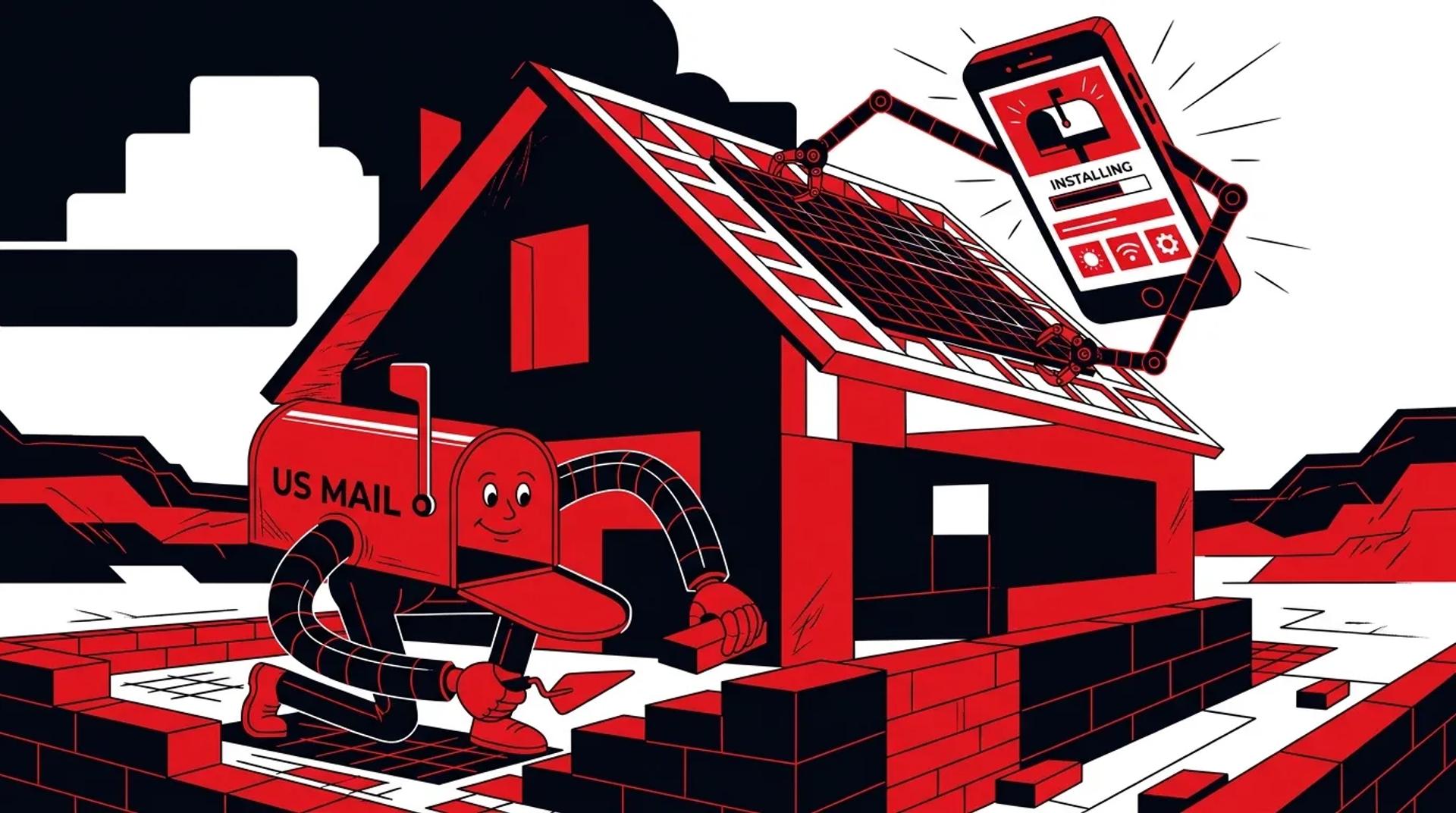

The debate between direct mail and digital marketing usually ends with someone declaring a winner. That misses the point entirely. These channels do different work, and the brands treating them as an either-or decision are leaving revenue on the table.
Direct mail for service businesses is not a nostalgic throwback. It is a physical touchpoint that cuts through the noise of a crowded inbox and an oversaturated social feed. But it also cannot retarget, optimize in real time, or capture intent at the moment of need. That is digital’s job.
We have run direct mail alongside digital campaigns for HVAC companies, dental practices, legal firms, and home services brands. The results are clear: the combination outperforms either channel in isolation, but only when each channel is assigned the right job.
What direct mail is uniquely good at
Direct mail lands in a physical space with almost zero competition. The average American gets 2-3 pieces of marketing mail per day versus 120+ emails. That difference in clutter is the entire advantage.
Here is what direct mail handles better than any digital channel:
- Physical persistence. A postcard sits on a kitchen counter for days or weeks. A digital ad disappears the moment someone scrolls past it.
- Household-level targeting. You can target every address in a specific zip code, neighborhood, or radius around your location. This is critical for direct mail for service businesses with defined service areas.
- Trust signal. Physical mail implies permanence and investment. For high-consideration purchases (legal services, home renovation, healthcare), that perceived credibility matters.
- No opt-in required. Unlike email marketing, you do not need permission to reach someone’s mailbox.
Where direct mail falls short
Direct mail has a fixed cost per piece regardless of whether the recipient is in-market. You cannot pause a mailing mid-flight if results are underperforming. And the feedback loop is slow. You are measuring response over weeks, not hours.
Where digital channels outperform direct mail
Digital’s strengths are speed, precision, and measurability. These are the jobs digital should own in your funnel:
- Real-time intent capture. Search ads reach people the moment they are looking for your service.
- Behavioral targeting. Retarget website visitors, lookalike audiences, and past customers with tailored messages.
- Rapid iteration. Test subject lines, offers, and creative in days. Direct mail testing takes weeks.
- Cost efficiency at scale. Digital CPMs can be lower for broad awareness, and you only pay for engagement on many platforms.
| Capability | Direct Mail | Digital Ads |
|---|---|---|
| Household targeting | Strong | Moderate |
| Inbox competition | Very low | Very high |
| Speed to market | 2-4 weeks | 1-3 days |
| A/B testing cycle | Weeks | Days |
| Response tracking | Moderate (codes, URLs) | Strong (pixels, calls) |
| Physical touchpoint | Yes | No |
| Real-time optimization | None | Strong |
| Average response rate | 2-5% | 0.5-2% (display) |
The response rate difference tells the story. Direct mail gets opened and read at a higher rate, but digital lets you test and optimize at a speed direct mail cannot touch.
How to split jobs across the funnel
Top of funnel: direct mail owns the doorstep
Use direct mail to introduce your brand to cold audiences in your service area. A well-designed postcard or letter with a clear offer (free estimate, introductory discount, seasonal promotion) puts your name in the household before they ever search for your service.
Mid-funnel: digital owns the follow-up
After the mailer drops, run geo-targeted digital ads in the same zip codes. The household that saw your postcard now sees your brand on Facebook, Instagram, or Google Display. This multi-touch exposure dramatically increases the odds of conversion.
Bottom of funnel: digital owns the capture
When the recipient is ready to act, they search your brand name or your service category. Search ads and a strong landing page capture that demand. Call tracking ties it back to revenue.
What creative changes by channel
Running the same offer on a postcard and a Facebook ad is fine. Running the same creative treatment is not. The context is different, and the creative has to reflect that.
Direct mail creative rules:
- Lead with the offer. The recipient decides in 2-3 seconds whether to read or recycle.
- One CTA. Phone number or a short, memorable URL.
- High-quality print and paper stock. Cheap mailers get treated like junk.
- Include a deadline to create urgency.
Digital creative rules:
- Platform-native formats (vertical video for Reels, carousel for Facebook, responsive for display).
- Multiple variants for testing.
- Retargeting creative should reference the offer from the mailer to create continuity.
- Strong landing page with call tracking and form capture.
The best direct mail strategy pairs a high-impact physical piece with a digital retargeting sequence that reinforces the same message across channels.
How Ad Leverage blends direct mail with digital
Our direct mail strategy starts with data. We analyze your customer file to identify the demographics, home values, and neighborhoods that produce the highest lifetime value. Then we build the mail list to match that profile.
Here is how we integrate the channels:
- List building. We use your CRM data plus third-party demographic overlays to build a targeted mail list. No spray-and-pray.
- Drop-and-digital sync. Digital campaigns launch the same week the mail drops. The audience sees your brand in their mailbox and on their phone within 48 hours.
- Unique tracking. Every mailer gets a unique phone number, promo code, or landing page URL so we can attribute responses directly.
- Response analysis. We measure direct mail ROI by comparing response rates, cost per lead, and cost per booked job against your digital-only benchmarks.
- Ongoing optimization. Underperforming zip codes get cut. High-performing neighborhoods get increased frequency. The list gets smarter every quarter.
This approach typically delivers a 20-40% lower cost per booked job compared to digital-only campaigns for local service businesses. The physical touchpoint warms the audience before digital captures the conversion.
Frequently asked questions
What is a good response rate for direct mail?
For direct mail for service businesses, a 1-3% response rate on a prospecting mailer is solid. Retention mailers to existing customers can hit 5-10%. The key metric is cost per booked job, not response rate alone.
How much should I budget for direct mail?
Plan for $0.50-$1.50 per piece for standard postcards including printing and postage. A meaningful test requires at least 5,000-10,000 pieces. For most local service businesses, that means a $3,000-$10,000 initial test budget.
Can direct mail work for lead generation or just brand awareness?
Direct mail is a strong lead generation channel when the offer is specific and the CTA is clear. Include a tracked phone number and a landing page URL. We consistently generate qualified leads at $30-80 per lead for service businesses using mail.
How often should I send direct mail?
Monthly or bi-monthly frequency works best for acquisition campaigns. Sending once and expecting results is the most common mistake. Consistency builds recognition, and recognition drives response.
Ready to add direct mail to your growth engine?
If you are evaluating direct mail for service businesses and want a plan that integrates mail with digital for maximum ROI, Talk to a Direct Mail Strategist. We will build you a campaign where every mailer has a tracked, measurable job.
References
- USPS, Household Diary Study on Mail Volume and Consumer Engagement
- Data & Marketing Association (DMA), Response Rate Report for Direct Mail vs. Digital Channels
- HubSpot, Integrated Marketing Campaign Performance Benchmarks