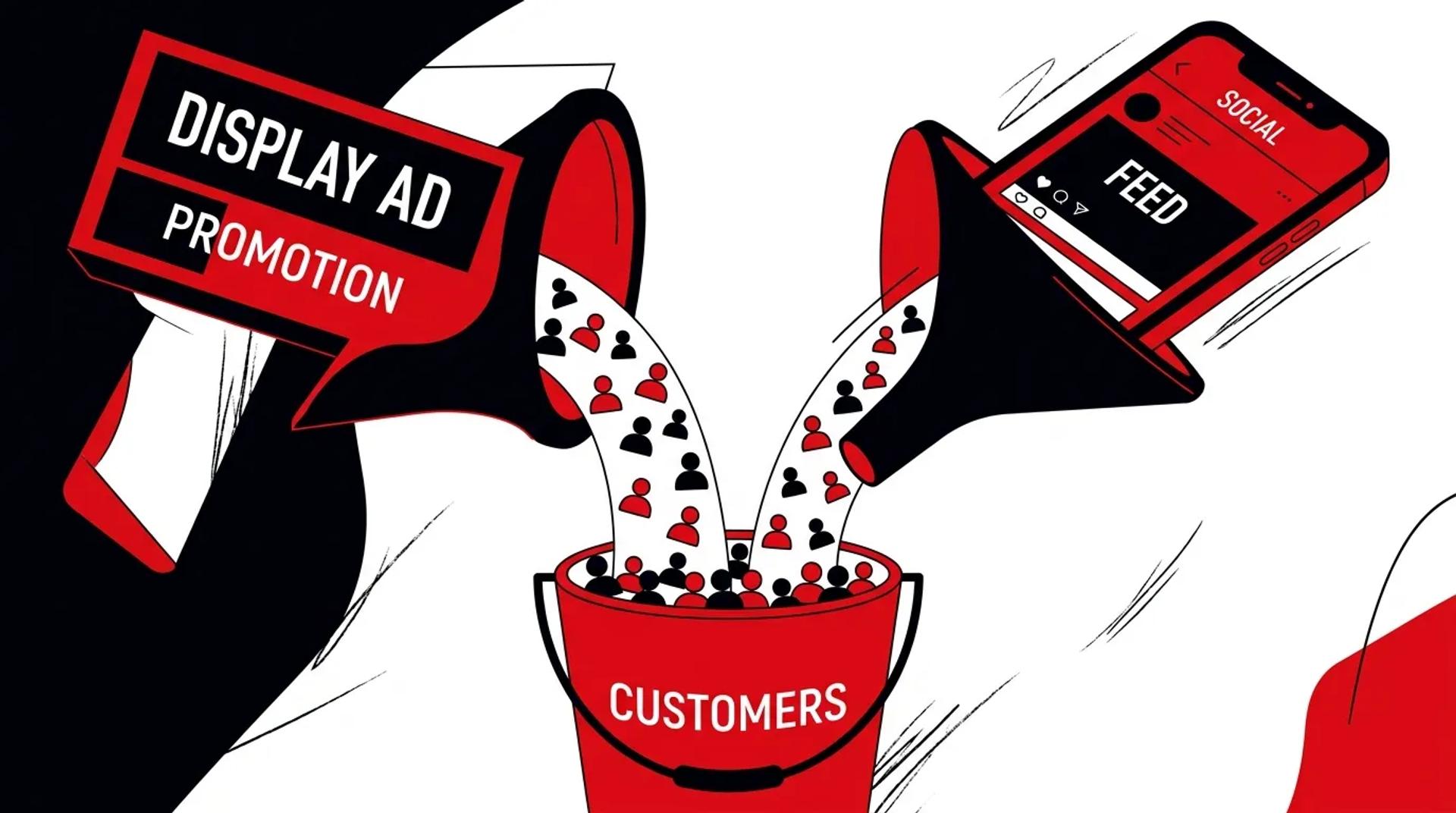

Most paid media teams run retargeting on both Google Display and paid social (Meta, LinkedIn, etc.) without a clear plan for what each channel should do. The result is overlap, frequency fatigue, and budget waste. The same user sees your banner on a news site, then the same message on Instagram, then again on Facebook. Three impressions, one message, zero incremental value.
The question is not whether to run display ads vs paid social retargeting. It is how to divide the work so each channel does what it does best without cannibalizing the other. When you split the job correctly, combined performance exceeds what either channel delivers alone.
We manage retargeting across both channels for dozens of accounts. The teams that treat them as one unified system outperform those that manage them in silos by 25-40% on cost per conversion.
What display does better than paid social
Google Display Network (GDN) retargeting has specific advantages that paid social cannot replicate.
Reach and inventory. GDN reaches 90%+ of internet users across 3 million+ websites and apps. No other single network offers that scale. For retargeting audiences that need high frequency across multiple touchpoints throughout the day, display delivers reach that social alone cannot match.
Always-on visibility. Display banners appear on news sites, blogs, forums, and apps where users spend significant time. This ambient presence keeps your brand visible outside of social media, which matters for audiences that do not spend much time on Instagram or Facebook.
Integration with Google Ads. Display retargeting lives in the same platform as your Search and Shopping campaigns. That means unified audience management, shared conversion tracking, and cross-channel attribution without platform conflicts.
Format flexibility. Responsive display ads, static banners, HTML5, and rich media formats give you creative options that social placements do not support.
Where display falls short
Display CTRs are low. Industry average is 0.35%. Most impressions are background noise. The user is reading an article, and your banner is competing with the content they came for. Display is effective for brand presence and frequency building, but it is not where deep engagement happens.
Ad fraud and placement quality are also concerns. Without proper exclusions and monitoring, your display budget can end up on junk inventory. Placement reports should be reviewed weekly and exclusion lists updated monthly.
Where social retargeting wins
Paid social retargeting has its own set of advantages that make it better suited for certain roles in your remarketing campaign strategy.
Attention quality. Social ads appear in the content feed. Users are actively scrolling and engaging. A well-designed retargeting ad on Instagram gets more conscious attention than a banner ad on a news sidebar. CTRs for social retargeting are typically 2-5x higher than display.
Creative depth. Carousel ads, video ads, lead forms, and interactive formats let you tell a richer story than a static banner. For retargeting sequences where you need to build trust or overcome objections, social formats give you more room.
Audience matching. Meta’s retargeting audiences are built on deep user-level data. Custom audiences from website visitors, email lists, and video viewers are highly precise. Match rates on customer lists tend to be 60-80% on Meta vs. 30-50% on Google Customer Match.
Engagement signals. Social retargeting generates measurable engagement. Comments, saves, shares, and reactions. These signals tell you how your message is landing and give the algorithm optimization data beyond just clicks and conversions.
| Capability | Google Display | Paid Social (Meta) |
|---|---|---|
| Audience reach | 90%+ of internet users | 2.9B monthly active users |
| Average retargeting CTR | 0.3-0.5% | 0.8-1.5% |
| Creative formats | Banners, responsive, HTML5 | Carousel, video, lead forms, stories |
| Audience match rate (email lists) | 30-50% | 60-80% |
| Attribution integration | Native with Google Ads | Separate platform, less cross-channel visibility |
| Average CPM | $2-6 | $8-15 |
| Ad fraud risk | Moderate (needs exclusions) | Low |
| Frequency control | Manual caps | Automated + manual |
How to avoid overlap and fatigue
Running both channels without coordination creates the biggest problem in retargeting: the user sees too many ads with the same message across too many places. This is not just a waste of budget. It actively damages brand perception.
Coordination strategies:
- Separate the audiences. Assign different retargeting windows to each channel. Example: display handles 0-7 day visitors, social handles 8-30 day visitors. Or segment by page visited. Display retargets service page visitors. Social retargets blog readers and video viewers.
- Set combined frequency caps. If your target is 8 impressions per user per week across all retargeting, allocate 4-5 to display and 3-4 to social. This requires manual coordination since the platforms do not talk to each other natively.
- Differentiate the message. Display shows the direct offer (schedule now, get a quote). Social shows social proof (testimonials, reviews, case studies). Same audience, different angles, no redundancy.
- Use exclusion lists. Suppress converters from both platforms immediately. Suppress display-engaged users from social audiences and vice versa if you want to test incremental lift.
The cross-platform attribution challenge
Neither Google nor Meta wants to share credit. Each platform will claim the conversion, inflating your total reported numbers. The fix:
- Use a single source of truth (CRM or analytics platform) that tracks conversions by user, not by platform
- Compare total conversions in your CRM against the sum of platform-reported conversions to identify overlap
- Run holdout tests. Turn off display retargeting for two weeks and measure total conversions. Then do the same for social. The drop tells you each channel’s incremental contribution.
Which channel should carry which message
The best display ads strategy paired with a social retargeting plan assigns different message types to each channel based on their strengths.
| Message Type | Best Channel | Why |
|---|---|---|
| Direct response CTA (book now, get quote) | Display | High frequency, low cost, ambient reminder |
| Social proof (reviews, testimonials) | Social | Higher engagement, video/carousel formats |
| Objection handling (pricing, process, FAQs) | Social | Carousel and video allow deeper explanation |
| Brand reinforcement (logo, tagline) | Display | Low CPM, high frequency, visual consistency |
| Educational content (blog posts, guides) | Social | Click-through to content works better in-feed |
| Limited-time offers | Both | Display for frequency, social for engagement |
Sequencing across channels
For full-funnel remarketing campaign strategy, build a cross-channel sequence:
Days 1-3 (hot visitors):
- Display: Direct CTA banner. “Get your free quote.” High frequency, 3-4 impressions/day.
- Social: Video testimonial from a similar customer. Social proof while the visit is fresh.
Days 4-14 (warm visitors):
- Display: Reduce frequency to 1-2 impressions/day. Shift to brand reinforcement.
- Social: Carousel ad addressing top 3 objections. Link to detailed service page.
Days 15-30 (cool visitors):
- Display: Pause or minimal spend. These users are unlikely to convert from a banner.
- Social: Retarget with educational content or a new angle. Blog post, case study, or guide.
This approach ensures each impression has a purpose. No duplication, no wasted frequency.
How Ad Leverage balances both
We manage display and social retargeting as a single system, not two separate campaigns run by two separate teams. Every client gets a unified retargeting plan that defines which channel owns which audience segment, which message, and which stage of the funnel.
Our display ads strategy and social retargeting framework:
- Audience architecture. Map all retargeting audiences by recency, page engagement, and funnel stage. Assign ownership to display or social based on channel strengths.
- Creative planning. Build separate creative for each channel. Display gets direct-response banners. Social gets video, carousels, and engagement-driven formats.
- Frequency management. Set combined caps across both channels. Monitor total impressions per user weekly.
- Attribution. CRM-based conversion tracking with platform-level data as a supplement. We report cost per booked job by channel and combined.
- Monthly optimization. Review overlap, adjust audience splits, refresh creative, and reallocate budget based on incremental contribution testing.
The result is higher display ads ROI, lower overall retargeting CPA, and a better user experience that protects brand perception.
Frequently asked questions
Should I run display retargeting and social retargeting at the same time?
Yes, but with intentional separation. Each channel should own a different part of the retargeting job. Running both with the same audience, same message, and no coordination wastes 20-30% of your combined retargeting budget on redundant impressions.
Which channel has better retargeting ROI?
It depends on your vertical and creative. Social retargeting typically delivers higher CTR and engagement rates. Display delivers more impressions at lower CPMs. In our accounts, blended retargeting ROI (both channels coordinated) outperforms either channel running solo by 25-40%. The value is in the combination, not the competition.
How much should I spend on retargeting vs. prospecting?
Retargeting should typically be 15-25% of your total paid media budget. Within that retargeting budget, split based on audience size and channel strengths. A common starting point is 60% display / 40% social, adjusted based on performance data after 60 days.
Is display retargeting still effective without third-party cookies?
Google has shifted to privacy-preserving APIs and first-party signals for audience targeting. Retargeting audiences built on Google’s logged-in user data (which covers the majority of Chrome users) remain effective. Supplement with customer match lists and first-party data strategies to maintain targeting precision as the ecosystem evolves.
Get started
If you are running retargeting on display and social without a unified strategy, you are likely overspending on overlap and underdelivering on results. Talk to a Paid Search Strategist and we will audit your current retargeting setup and build a coordinated plan that gets more conversions from the same budget.
References
- Google Ads Help Center. “About Remarketing and Display Campaigns.”
- Meta Business Help Center. “Retargeting Best Practices.”
- SEMrush. “Display Advertising vs. Social Media Advertising Study.”