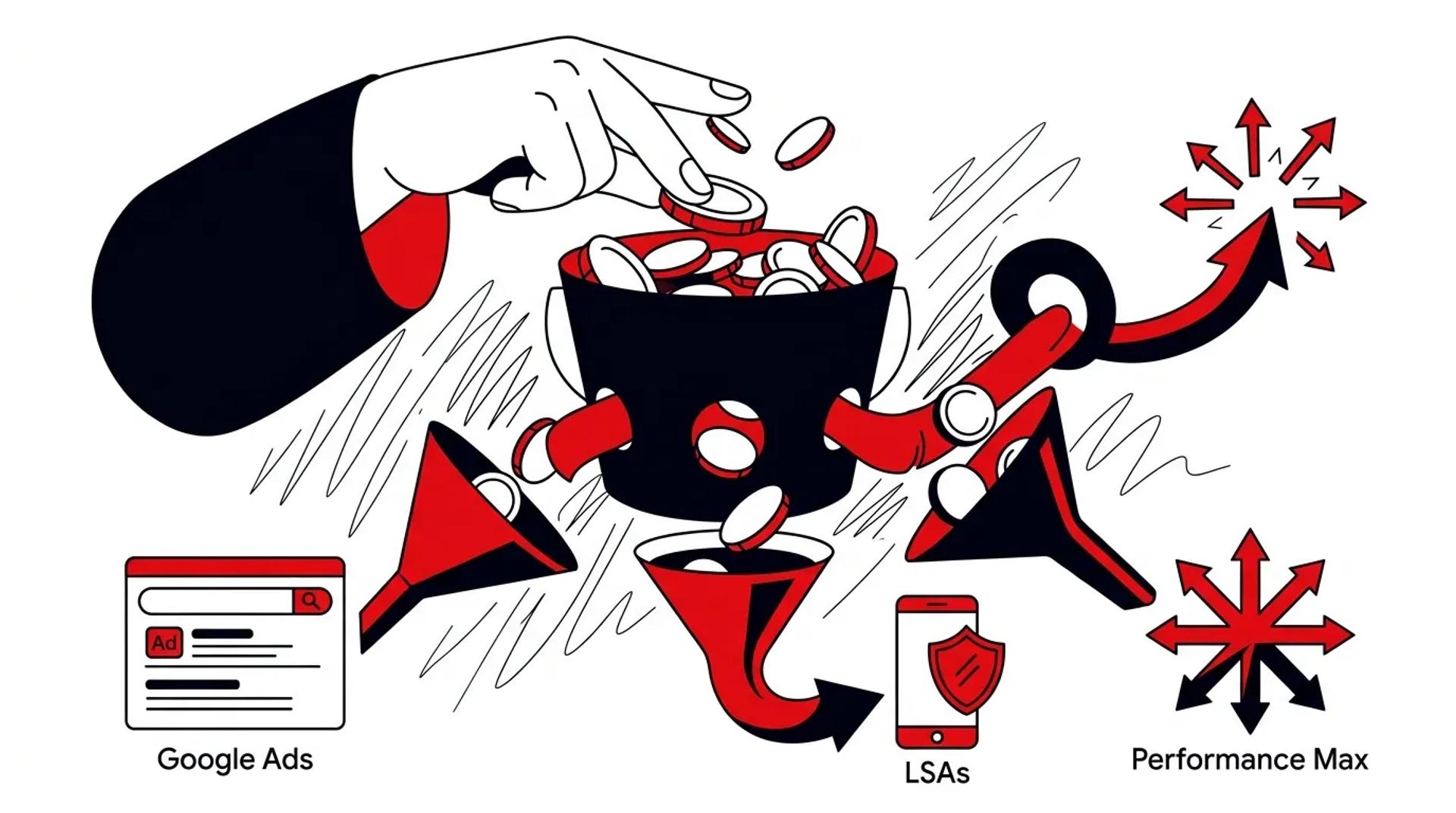

Google now gives service businesses three distinct ways to show up in search results. Standard Google Ads (Search campaigns), Local Services Ads, and Performance Max. Most businesses either spread budget evenly across all three or dump everything into whichever one their account rep recommended last quarter. Both approaches leave money on the table.
The real question when comparing Google Ads vs Local Services Ads and Performance Max is not which one is “best.” Each channel has a different job. The right Google Ads budget allocation depends on understanding what each channel actually does well, where it falls short, and how they interact with each other.
We manage all three channels for service businesses ranging from single-location shops to multi-state operations. The allocation model that works is not static. It shifts based on lead quality data, seasonality, and capacity. Here is how to think about it.
What each channel is built to do
Before splitting budget, you need to understand what you are buying with each dollar.
Google Ads (Search) gives you the most control. You choose keywords, write ads, set bids, and send traffic to your own landing pages. You own the conversion experience. The tradeoff is higher management complexity and typically higher CPCs in competitive verticals.
Local Services Ads sit at the very top of the SERP with a Google Guarantee badge. You pay per lead, not per click. Google controls the matching, the ad format, and the lead experience. You get phone calls and messages directly through the platform. Less control, but often lower cost per lead for high-intent local queries.
Performance Max is Google’s automated campaign type that runs across Search, Display, YouTube, Gmail, Maps, and Discover. You provide assets and conversion goals. Google’s algorithm decides where and when to show your ads. Reach is massive, but transparency is limited.
| Factor | Google Ads Search | Local Services Ads | Performance Max |
|---|---|---|---|
| Pricing Model | Cost per click | Cost per lead | Cost per click (automated) |
| Targeting Control | Full keyword control | Google matches you | Audience signals only |
| Landing Page | Your own pages | Google-hosted profile | Your own pages |
| Lead Quality Levers | Keywords, negatives, audiences | Service categories, reviews | Asset groups, signals |
| Reporting Depth | Full search term, keyword, device | Lead type, service category | Limited. Mostly aggregate |
| Best For | High-intent, high-value services | Local, urgent service calls | Broad awareness + remarketing |
Where Google Ads search should get the largest share
For most service businesses, standard Search campaigns should anchor your Google Ads strategy. This is where you capture people actively searching for what you sell with full control over the experience.
Prioritize Search budget for:
- Non-branded, high-intent keywords (“emergency plumber near me,” “commercial HVAC repair”)
- Service lines with the highest margin or ticket size
- Markets where you need precise geographic targeting
- Campaigns where you need clean data to optimize CRM-connected conversions
Search is also where Google Ads cost per lead is most predictable once you have 60-90 days of data. You can forecast spend and lead volume with reasonable accuracy, which matters when you are planning capacity and dispatching.
When to increase search budget
Push more into Search when you have landing pages converting above 5%, strong call tracking in place, and CRM data flowing back for offline conversion optimization. That feedback loop is what makes Search scale profitably.
How Local Services Ads should complement search
LSAs are not a replacement for Search campaigns. They are a complement. Google Ads vs Local Services Ads is not an either/or decision for most service businesses.
LSAs work best when:
- You serve residential customers in defined local areas
- Your Google Business Profile has strong reviews (4.5+ stars, 50+ reviews)
- You can answer or return calls quickly (speed to lead matters here)
- You want to capture the very top of the SERP on mobile
LSAs struggle when:
- You need to control the sales experience (leads go through Google’s interface, not yours)
- You sell complex or high-consideration services that need education before conversion
- Your team cannot respond to leads within minutes
- You need detailed attribution data for multi-touch funnels
We typically see LSA leads convert to booked jobs at a slightly lower rate than Search leads, but at a lower cost per lead. The net cost per booked job often ends up comparable. The incremental volume is what makes them valuable.
When Performance Max earns its budget
Performance Max is the channel we are most cautious about for lead gen businesses. The reach is broad, but the lack of transparency makes it hard to separate incremental conversions from cannibalized ones.
PMax earns budget when:
- You have strong conversion tracking with offline import data
- You have tested it in isolation and can measure true lift
- You are using it for top-of-funnel awareness in combination with Search for capture
- Your asset groups are tightly built with specific audience signals
PMax burns budget when:
- It is running alongside Search with no incrementality measurement
- Your conversion actions are weak (form submissions without lead quality signals)
- You are relying on Google’s default reporting to evaluate performance
- You have not excluded branded terms and the campaign is feasting on existing demand
A common PMax trap
We regularly audit accounts where Performance Max looks like the best performer on paper. Low CPA, high conversion volume. Then we check the search terms report (what little Google exposes) and find 40-60% of conversions are branded queries. That is not incremental demand. That is your brand campaign wearing a PMax disguise.
A starting framework for budget allocation
There is no universal split, but here is a framework that works for most service businesses starting to run all three channels.
| Business Stage | Google Search | LSAs | PMax |
|---|---|---|---|
| Just starting paid search | 80% | 20% | 0% |
| Established, scaling | 55-65% | 20-25% | 15-20% |
| Multi-location, full coverage | 45-55% | 25-30% | 15-25% |
| Maxed out on Search volume | 40-50% | 25-30% | 20-30% |
Key principles behind this framework:
- Search gets the lion’s share until you have hit diminishing returns on your core keywords
- LSAs get consistent budget because they occupy premium SERP real estate at predictable cost
- PMax gets budget only after Search and LSAs are optimized and you can measure incrementality
- Revisit the split monthly based on cost per booked job by channel, not cost per lead
How to measure across channels fairly
Comparing Google Ads cost per lead across these three channels requires normalizing for lead quality. A $30 LSA lead that converts to a booked job 20% of the time is not better than a $60 Search lead that converts at 45%.
The metrics that matter for comparison:
- Cost per booked job (not cost per lead)
- Revenue per dollar spent by channel
- Lead-to-job close rate by channel
- Incrementality. Would you have gotten this lead without this channel?
Use your CRM as the source of truth. Tag every lead by source channel and follow it through to revenue. Platform-reported numbers will always look better than reality.
Frequently asked questions
Should I pause Google Ads if LSAs are cheaper per lead?
No. LSA volume has a ceiling. Google controls how many leads you receive based on your budget, reviews, and proximity. Search campaigns give you the ability to scale beyond that ceiling and capture different types of intent. Running both maximizes your SERP coverage.
How much should I spend on Performance Max for lead gen?
Start with 10-15% of your total Google budget and run it for 60 days with proper incrementality tracking. If cost per booked job from PMax is within 20% of your Search campaigns after accounting for brand cannibalization, it is worth continuing. If not, reallocate to Search and LSAs.
Can I run all three channels without them competing against each other?
They will overlap to some degree. The goal is not zero overlap. It is understanding the overlap so you can allocate intelligently. Brand exclusions in PMax, tight keyword targeting in Search, and strong LSA profiles reduce wasted competition between your own campaigns.
Stop guessing with your budget
The right allocation across Google Ads, LSAs, and Performance Max is not a set-it-and-forget-it decision. It requires clean data, consistent measurement, and a willingness to shift spend based on what is actually producing booked jobs. Talk to a Paid Search Strategist who can audit your current channel mix and build an allocation model tied to revenue, not platform vanity metrics.
References
- Google Ads Help Center. About Performance Max campaigns.
- Search Engine Land. Local Services Ads vs Google Ads. When to Use Each.
- HubSpot. Google Ads Benchmarks for Lead Generation.