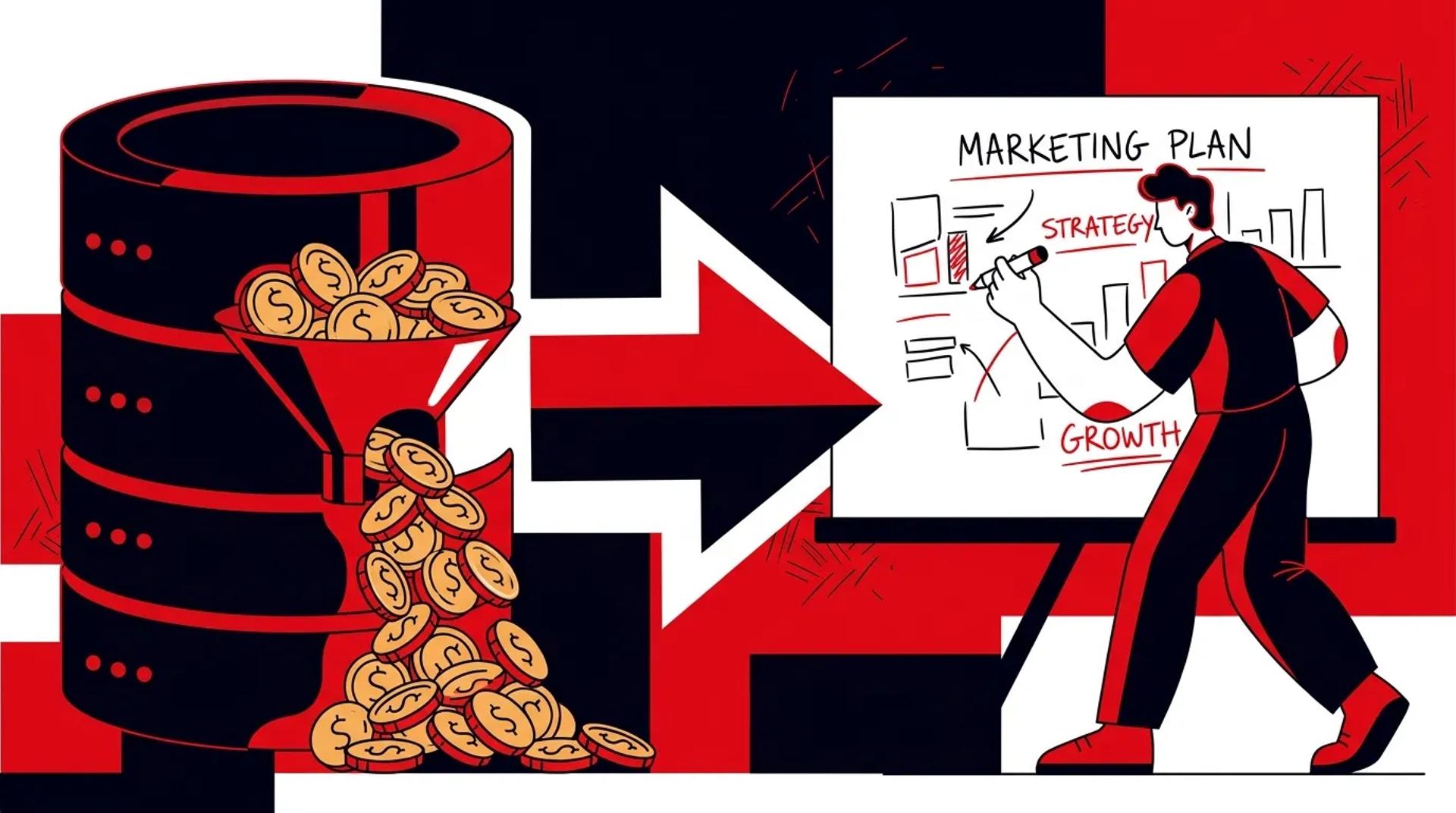

Your CRM knows which leads became customers, what they spent, and which jobs closed. Your marketing platform knows which campaigns generated those leads. The problem is that in most home service businesses, those two systems do not talk to each other. Marketing optimizes for leads. Operations tracks revenue. Nobody connects the two.
This is why CRM revenue attribution is the single most impactful capability a service business can build into its marketing stack. Without it, you are allocating budget based on cost per lead and gut instinct. With it, you are allocating budget based on actual revenue contribution by channel, campaign, and keyword. The difference between those two approaches is the difference between growing profitably and guessing your way through each quarter.
We see this disconnect in almost every new client engagement. The marketing looks healthy on paper: leads are flowing, CPL is stable, the agency sends a clean report every month. But the owner knows something is off because revenue is not growing proportionally. The reason is almost always the same. The leads that “look good” in marketing reports are not the leads that produce booked jobs and completed revenue.
Why CRM revenue data matters upstream
Marketing without revenue data is flying blind
When your marketing team only sees leads, they optimize for lead volume and cost per lead. Those are input metrics. They tell you how much raw material is entering the system. They say nothing about what comes out.
Consider two campaigns running in the same month:
| Campaign | Leads | CPL | Booked Jobs | Revenue | Cost Per Booked Job | Revenue:Spend |
|---|---|---|---|---|---|---|
| Campaign A | 85 | $52 | 22 | $14,300 | $201 | 3.2:1 |
| Campaign B | 45 | $88 | 28 | $31,500 | $141 | 7.9:1 |
If your marketing team only sees leads and CPL, Campaign A looks better. It produced more leads at a lower cost. But Campaign B generated nearly twice the revenue at a better cost per booked job and a dramatically better return on spend. Without CRM revenue attribution, you would shift budget toward Campaign A and away from Campaign B. That is a profitable growth decision made in reverse.
Revenue data changes every budget conversation
When you can show the owner or CFO “this channel produced $180,000 in completed job revenue last quarter on $22,000 in spend,” the budget conversation changes from “how much can we afford?” to “how much should we invest?” Revenue attribution turns marketing from a cost center into a measurable growth engine.
Which systems need to connect
The data chain from click to cash
For CRM revenue attribution to work, data needs to flow through a connected chain:
- Ad platform. Records the click, keyword, campaign, and cost.
- Call tracking / form tracking. Captures the lead and tags it with the marketing source.
- CRM. Creates the customer record, tracks the appointment, and records the job outcome and revenue.
- Reporting layer. Pulls data from all three and stitches it into a unified view.
If any link in that chain breaks, attribution breaks.
Common system combinations in home services
| CRM | Call Tracking | Ad Platforms | Reporting |
|---|---|---|---|
| ServiceTitan | CallRail | Google Ads, LSAs, Meta | Custom dashboard or n^sight |
| Housecall Pro | CallRail or built-in | Google Ads, LSAs | Custom dashboard or n^sight |
| FieldEdge | CallRail | Google Ads, LSAs, Meta | Custom dashboard or n^sight |
The specific tools matter less than the connections between them. Every system needs to pass data forward and accept data back.
What must flow between systems
- From ad platform to tracking: Campaign, ad group, keyword, UTM parameters
- From tracking to CRM: Lead source, phone number or form ID, marketing tags
- From CRM to reporting: Customer record, booked job status, completed job revenue, service type, agreement status
- From reporting back to ad platform: Offline conversion data (which leads became revenue)
What teams often miss in implementation
Missing offline conversion imports
Google Ads can optimize toward booked revenue if you feed it the data. Most home service businesses do not. They let the algorithm optimize for form fills and phone calls, which means it learns to find people who click and call, not people who book and pay. Offline conversion imports close this loop.
Broken source tagging
The most common attribution failure is not a technology problem. It is a process problem. A CSR takes a call, creates the customer record, and selects “Web” as the source because there is no tracking number attached. Or the tracking number was not provisioned for that campaign. Or the form submission lost its UTM data on redirect. One broken tag means one lost data point. Multiply that across hundreds of leads per month and your attribution becomes unreliable.
CRM data hygiene
Revenue attribution requires clean CRM data. If jobs are not marked as completed, if revenue is not entered accurately, or if customer records are duplicated, the numbers downstream are wrong. Garbage in, garbage out.
Common CRM hygiene issues:
- Jobs marked as “booked” but never updated to “completed” or “invoiced”
- Revenue entered on the wrong job or the wrong customer
- Duplicate customer records that split history
- Missing or incorrect lead source tags
- Service agreements not linked to the original marketing source
No single source of truth
When marketing pulls data from the ad platform, operations pulls data from the CRM, and finance pulls data from the accounting system, you get three different versions of “how marketing performed.” A marketing attribution platform creates one view that everyone trusts.
How better data changes budget allocation
Shift spend toward revenue, not leads
Once you can see revenue by channel, the budget allocation framework changes.
Before attribution: “Google Ads is our biggest lead source, so it gets the biggest budget.”
After attribution: “Google LSAs produce fewer leads but 2x the revenue per dollar. Organic search produces the highest-ticket jobs. Google Ads non-brand is efficient for emergency demand but weak on replacements. Reallocate 15% of non-brand budget to LSA expansion and content investment.”
Identify and cut waste
Revenue data exposes the channels and campaigns that produce leads that never convert. A campaign that generates 50 leads at $40 CPL looks productive. But if only 3 of those leads booked and the average ticket was $280, the campaign produced $840 in revenue on $2,000 in spend. That is not a lead problem. That is a revenue problem. Without CRM revenue attribution, that campaign keeps running.
Prove marketing’s contribution to the business
The owner does not care about click-through rates. They care about whether marketing is producing enough revenue to justify the spend. Revenue attribution gives you the data to answer that question directly, by channel, by month, by quarter.
The revenue attribution maturity model
Not every business needs (or is ready for) full closed-loop attribution on day one. Here is a phased approach.
| Level | What You Track | What You Can Do |
|---|---|---|
| Level 0: No attribution | Leads by source (if that) | Nothing. You are guessing. |
| Level 1: Lead source tracking | Leads by channel with call/form tracking | Allocate budget by lead volume per channel |
| Level 2: Booked job tracking | Leads that converted to booked appointments by source | Allocate budget by cost per booked job |
| Level 3: Revenue tracking | Completed job revenue by marketing source | Allocate budget by revenue contribution |
| Level 4: Lifetime value tracking | Revenue + agreement status + repeat purchases by source | Allocate budget by customer lifetime value |
Most home service businesses are at Level 0 or Level 1. Getting to Level 2 is a significant improvement. Level 3 is where budget decisions become truly data-driven. Level 4 is where you start building a competitive moat.
How Ad Leverage uses n^sight to close the loop
At Ad Leverage, we built n^sight as a marketing attribution platform specifically for service businesses that need revenue-connected reporting. It is not a dashboard that makes CPL charts look pretty. It is a system that connects your CRM revenue data back to every marketing decision.
What n^sight does:
- Connects ad platforms to CRM. Every lead carries its marketing source from click through to completed job revenue.
- Automates offline conversion imports. Google Ads and other platforms receive booked and completed job data so the algorithms optimize toward revenue, not just leads.
- Produces revenue-first reporting. Every report starts with booked jobs and revenue by channel. Leads and CPL are secondary context.
- Enables multi-channel marketing reporting that shows how channels work together, not just in isolation.
The goal is simple. When you sit down to make a budget decision, you should be able to see exactly how much revenue each dollar produced. That is what CRM revenue attribution makes possible.
Frequently asked questions
How accurate is CRM revenue attribution?
No attribution model is 100% accurate. The goal is directionally correct data that is far better than guessing. With proper source tagging, call tracking, and CRM hygiene, most businesses can attribute 70% to 85% of their booked revenue to a specific marketing source. That is enough to make dramatically better budget decisions.
What if we use multiple CRMs or dispatch systems?
You need a reporting layer that aggregates data from all systems. n^sight and similar platforms can pull from multiple sources and normalize the data into a single attribution view. The alternative (manual spreadsheets pulling from different systems) is time-consuming and error-prone.
Does this work for multi-location businesses?
Yes. In fact, multi-location businesses benefit the most because performance varies significantly by market. A campaign that works in Phoenix might underperform in Denver. Revenue attribution by location lets you allocate budget based on what is actually working in each market, not what works on average.
How long does it take to set up?
Basic lead source tracking (Level 1) can be implemented in a week. Booked job tracking (Level 2) typically takes 2 to 3 weeks depending on your CRM. Full revenue attribution (Level 3) takes 4 to 6 weeks because it requires CRM configuration, call tracking setup, offline conversion imports, and reporting buildout. The ROI on that setup time is significant and immediate.
Book a strategy call
If your marketing reports stop at leads and CPL, you are making budget decisions without the most important data point: revenue. Every month that passes without CRM revenue attribution is a month where you might be overspending on channels that produce leads but not revenue, and underspending on channels that quietly drive your best customers.
We will audit your current data flow from ad platforms through your CRM, identify where attribution breaks, and build a plan to connect marketing spend to completed job revenue.
Book a Strategy Call to see what your marketing performance looks like when you measure what actually matters.
References
- Google Ads Help - Offline conversion tracking and enhanced conversions for leads
- HubSpot - Revenue attribution reporting and closed-loop marketing analytics
- CallRail - Call tracking integration and multi-touch attribution for service businesses