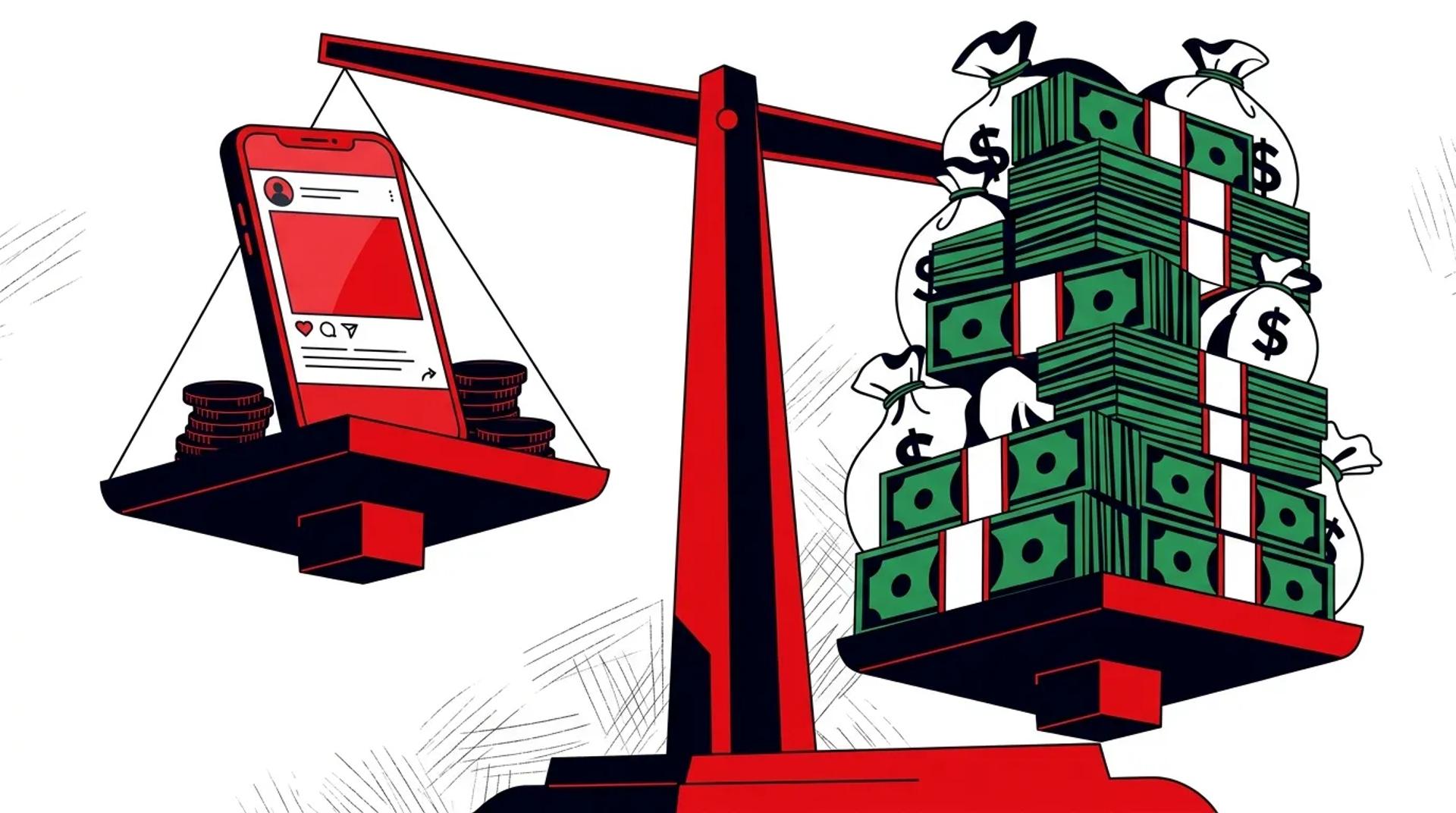
Organic social media has a measurement problem. Most teams track likes, impressions, and follower growth, then present those numbers as proof the channel is working. But when leadership asks “how many leads did organic social generate last quarter,” the room goes quiet.
The truth is that organic social for service brands operates differently than it does for DTC or e-commerce. You are not driving impulse purchases. You are building trust over weeks and months so that when a prospect needs your service, you are the first call they make. That journey is harder to measure, but it is absolutely measurable.
We have built organic programs for service businesses across dozens of verticals. The ones that prove ROI all do the same thing. They measure the right metrics, connect them to the CRM, and report on outcomes instead of activity.
Why most organic social metrics are misleading
Impressions tell you the platform showed your content. They do not tell you anyone cared. Follower count tells you people clicked a button once. It does not predict whether they will ever buy from you.
The problem is that social platforms are designed to show you metrics that make you feel good about using the platform. They want you to keep posting. Organic social for service brands requires a completely different measurement lens. One focused on business outcomes.
Here is the split between metrics that matter and metrics that distract:
| Metric Type | Vanity Metrics | Business Metrics |
|---|---|---|
| Awareness | Impressions, reach | Branded search lift, direct traffic from social |
| Engagement | Likes, comments count | Saves, shares, DM conversations started |
| Conversion | Link clicks | Leads generated, calls booked from social |
| Retention | Follower growth | Repeat engagement rate, customer content shares |
If your monthly report is heavy on the left column and light on the right, you are measuring effort, not impact.
The four metrics that connect organic social to revenue
1. Social-to-site conversion rate
Track the percentage of social visitors who take a meaningful action on your website. Not just page views. Meaningful actions. Form fills, phone calls, chat initiations, or appointment bookings.
Use UTM parameters on every link in your social content calendar so you can track exactly which posts drive which actions. Without UTMs, Google Analytics lumps all social traffic together and you lose the ability to optimize by content type.
2. Assisted conversions from social
Most organic social conversions are not last-click. A prospect sees your content three or four times before they visit your site directly and convert. If you only measure last-click, organic social gets zero credit for those conversions.
In Google Analytics 4, check the conversion paths report to see how often organic social appears as an assist. We typically see organic social involved in 15-30% of conversion paths for service brands, even when it gets less than 5% of last-click credit.
3. Branded search lift
This is the metric most teams miss entirely. Strong organic social drives branded search volume. People see your content, remember your name, and Google you later. Track branded search impressions in Google Search Console and overlay it with your posting cadence. If branded search rises when you post consistently and drops when you go quiet, organic social is earning you demand.
4. Pipeline velocity for social-touched leads
Tag every lead who interacted with your social content before converting. Then compare their pipeline velocity (time from lead to close) against leads who did not engage with social. We consistently see that social-touched leads close 20-35% faster because they arrive with higher trust and more context about what you do.
How to build a reporting framework your CEO will actually read
Executives do not want a 20-page deck about engagement rates. They want answers to three questions: Is this channel generating demand? Is it worth what we are spending? Should we invest more or less?
Structure your organic social media strategy reporting around these pillars:
Monthly business metrics (one page)
- Leads generated or influenced by organic social
- Revenue attributed to social-touched leads
- Branded search lift percentage
- Cost per social-influenced lead vs. other channels
Quarterly content performance (one page)
- Top 5 posts by business outcome (not by likes)
- Content format performance comparison (video vs. carousel vs. static)
- Posting frequency vs. lead volume correlation
- Audience growth in target demographic segments
Annual strategic review
- Year-over-year pipeline influence trend
- Channel efficiency compared to paid social, email, and search
- Recommendations for resource allocation
The content calendar connection
Your social content calendar should be structured around measurement, not just scheduling. Every post should have a clear intent tag:
- Awareness: Designed to reach new audiences (measure: new follower quality, branded search lift)
- Engagement: Designed to deepen relationships (measure: saves, shares, DM conversations)
- Conversion: Designed to drive action (measure: link clicks, leads generated)
- Retention: Designed to keep existing customers engaged (measure: repeat interactions, referral content)
When your calendar is tagged this way, you can measure whether your content mix is balanced and whether each category is performing against its own goals.
Common measurement mistakes that kill organic programs
Comparing organic to paid on the same metrics
Organic and paid social serve different functions. Paid is direct response. Organic is relationship building. When you compare them on cost-per-lead alone, organic always loses. The right comparison is cost per pipeline-influenced dollar, which accounts for the trust-building role organic plays.
Measuring weekly instead of quarterly
Organic social compounds. A single week of data means nothing. A single month is barely a signal. You need at least 90 days of consistent posting and tracking before you can make any meaningful judgment about whether the channel is working.
Ignoring dark social
A huge portion of organic social sharing happens in places you cannot track. People screenshot your posts and text them to colleagues. They share links in Slack channels and WhatsApp groups. This is dark social, and it means your measured results are always an undercount. Factor this into your expectations.
| Mistake | Impact | Fix |
|---|---|---|
| Comparing organic to paid on CPL | Organic gets defunded prematurely | Use pipeline influence as the primary metric |
| Weekly measurement cycles | Every week looks like failure | Report on 90-day rolling windows |
| Ignoring dark social | Undervaluing the channel by 30-50% | Use branded search lift as a proxy |
| No UTM discipline | Cannot attribute any conversions | Tag every link, every time |
Frequently asked questions
How many leads should organic social generate per month?
It depends on your posting volume, audience size, and industry. For most service brands posting 3-5 times per week, a reasonable benchmark is 5-15 qualified leads per month directly from social, with another 20-40 leads influenced by social in their conversion path.
Is organic social worth it if our reach keeps declining?
Yes, because reach is the wrong metric. Even with declining organic reach, the people who do see and engage with your content are increasingly qualified. Focus on engagement quality and conversion rate rather than raw reach numbers.
How long before we see ROI from an organic social media strategy?
Plan for 90-120 days before you have enough data to measure accurately. Most brands start seeing clear pipeline influence by month four or five. The compounding effect means months six through twelve typically deliver 2-3x the results of months one through five.
Should we invest in organic social or put everything into paid?
Both, but for different reasons. Paid generates leads now. Organic builds the trust layer that makes every other channel more effective. Brands that run paid without organic consistently see higher CPAs and lower close rates compared to brands that invest in both.
Stop guessing whether organic social is working
If your organic social reporting cannot answer “how does this connect to revenue,” it is time to rebuild the measurement framework. The metrics above give you the structure. The discipline of tagging, tracking, and reporting on business outcomes instead of vanity metrics gives you the proof.
Talk to a Social Strategy Lead to build an organic program that proves its own ROI every month.
References
- Google, “GA4 Attribution and Conversion Paths Documentation”
- Sprout Social, “The State of Social Media 2025”
- HubSpot, “Social Media Benchmarks for B2B and Service Industries”