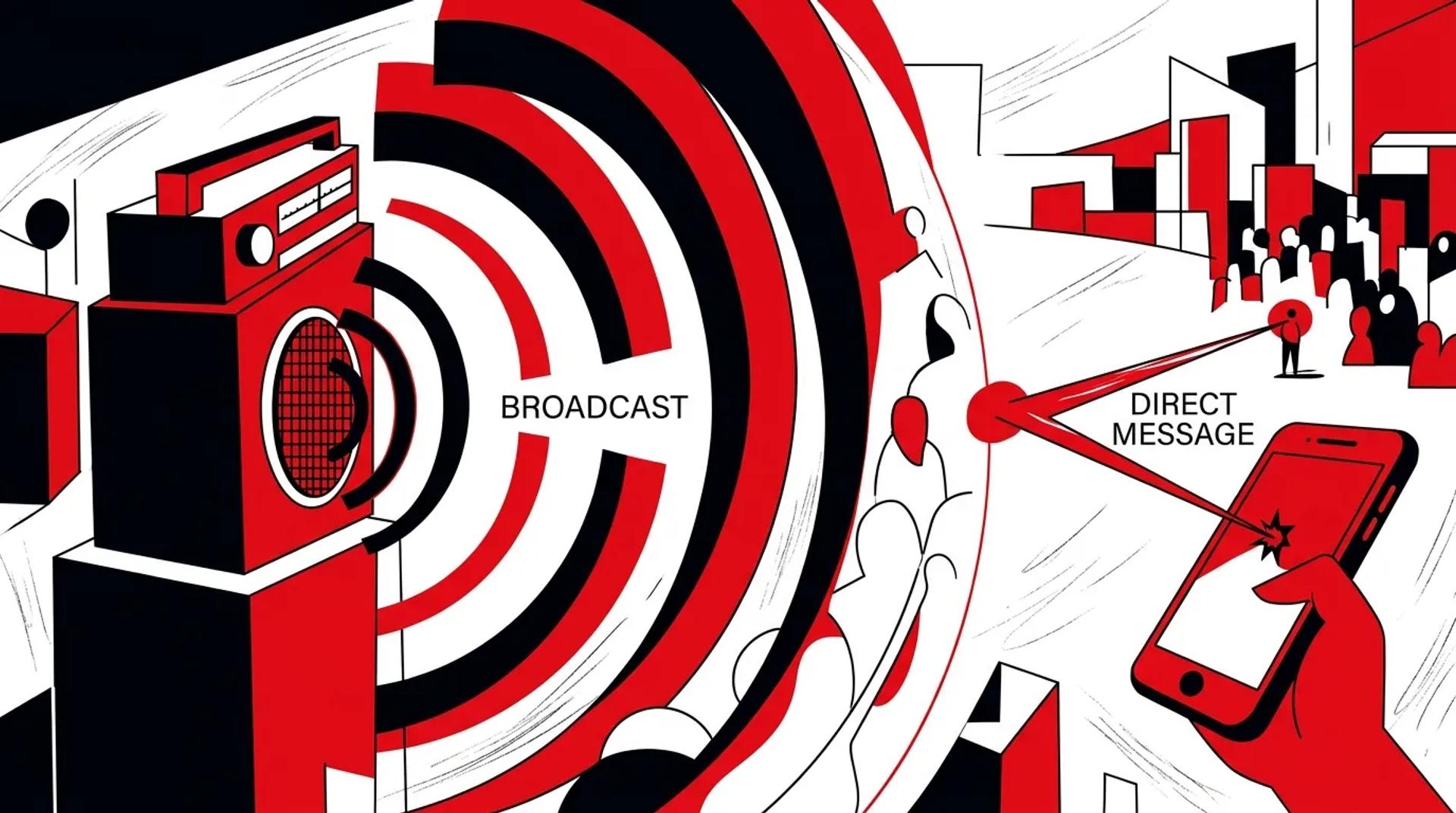

The radio vs streaming audio decision is not about choosing sides. It is about understanding that terrestrial radio and streaming audio platforms like Spotify, Pandora, and iHeart reach audiences in different contexts, at different times, and with different levels of targeting precision. Treating them as interchangeable is the fastest way to waste budget on both.
Radio still reaches over 80% of US adults weekly. Streaming audio is growing fast but skews younger and more urban. The question is not which one is alive and which one is dead. The question is what job each should do in your media plan.
We run radio advertising strategy alongside streaming audio and digital for local and regional businesses. The brands that win are the ones that assign each channel a specific role instead of making them compete for the same KPIs.
What radio is uniquely good at
Terrestrial radio delivers something no digital channel can match: mass local reach with a trusted voice. When a morning show host reads your ad live, that is an endorsement. When a pre-recorded spot runs during drive time, it reaches every car on the road. No targeting filters required because the geography IS the targeting.
What radio does best:
- Mass local reach. A single station can reach 100,000+ listeners in a metro area. No digital platform matches this penetration for local audiences.
- Personality endorsement. Live reads by popular hosts carry implicit trust. The host is lending their credibility to your brand.
- Drive-time captive audience. Commuters cannot skip or scroll. They are a captive audience for 30-60 minutes. This attention window is unique to radio.
- Frequency at scale. Running 20-30 spots per week on a station builds recall quickly. The repetition compounds in a way that scattered digital impressions do not.
Where radio falls short
Radio cannot target by interest, behavior, or intent. You buy a station’s audience, not a specific consumer profile. There is no visual component, which limits creative impact. And measurement is harder than any digital channel.
Where digital and streaming audio outperform radio
Streaming audio and digital channels win on precision and measurability:
- Audience targeting. Spotify and Pandora let you target by age, gender, music taste, location, and listening behavior. Radio targets by station format only.
- Clickable ads. Streaming audio includes companion display banners and clickable CTAs. Radio has no click path.
- Attribution. Streaming platforms provide impression-level reporting. Radio gives you spot logs and correlation analysis.
- Budget flexibility. You can test streaming audio with $1,000. Radio typically requires $3,000-$10,000 minimum monthly commitments.
| Capability | Terrestrial Radio | Streaming Audio | Other Digital |
|---|---|---|---|
| Local reach | Very high | Moderate | Variable |
| Audience targeting | Station format | Demographic + behavioral | Granular |
| Skip/scroll behavior | Cannot skip | Some skippable | Mostly skippable |
| Host endorsement | Yes (live reads) | No | No |
| Clickable CTA | No | Yes (companion banner) | Yes |
| CPM range | $5-15 | $15-30 | $5-30 |
| Measurement | Spot log correlation | Impression-level | Click-level |
| Budget minimum | $3,000-10,000/mo | $1,000/mo | Flexible |
How to split jobs across the funnel
Top of funnel: radio owns mass awareness
Radio is your reach weapon for a local market. Use it to make your brand name familiar to the broadest possible audience in your geography. The creative should focus on one simple message: who you are, what you do, and why someone should remember you.
Mid-funnel: streaming audio owns targeted reinforcement
After radio establishes broad awareness, streaming audio reinforces the message with more precisely targeted audiences. Younger demographics and specific interest groups that may under-index on radio listenership get reached here. The companion banner provides a visual reinforcement and a click path.
Bottom of funnel: digital owns conversion
Search ads, social retargeting, and landing pages capture the demand that radio and streaming audio created. The person who heard your name on the radio 15 times this month and then saw your streaming audio ad now searches your name on Google. Search captures the conversion. But radio and audio did the work.
What creative changes by channel
Running the same script on radio and streaming audio is tempting but suboptimal. The listening contexts are different.
Radio creative rules:
- Live reads beat produced spots for local businesses. The host’s personality and trust transfer to your brand.
- Keep it to one message. You have 30-60 seconds. Do not try to list every service.
- Repeat the brand name 3 times minimum. Listeners cannot look it up while driving.
- Use a vanity URL or memorable phone number. They need to remember it without writing it down.
Streaming audio creative rules:
- 15-30 second spots work best. Attention spans on streaming are shorter.
- Include a companion display banner. This is your visual and your click path.
- More specific targeting means more specific messaging. Speak to the audience segment you are targeting.
- CTA can be more direct. “Tap the banner to book” works here because the listener has a screen in hand.
Digital creative rules:
- Platform-native formats. Responsive for search, visual for social, vertical for Stories.
- Retargeting creative should reference the audio message. Continuity across channels increases conversion rates.
- Test multiple variants. Digital is your testing laboratory.
How Ad Leverage blends radio with digital
Our radio advertising strategy starts with audience data. We analyze your target customer profile, identify which stations they listen to, and map listening habits by daypart. Then we build a plan where radio and digital each have an assigned job.
Here is the integration framework:
- Station selection. We match stations to your target demographic using Arbitron/Nielsen Audio data, not rep recommendations.
- Daypart strategy. Morning and afternoon drive for maximum reach and response. Midday and evening for frequency building at lower cost.
- Digital geo-matching. Digital campaigns target the same metro area as the radio buy. The audience sees your name on the radio and on their phone within the same day.
- Measurement system. Tracked phone numbers and vanity URLs on radio spots. Branded search and call volume lift tracked weekly. Daypart correlation analysis to identify the best-performing time slots.
- Cross-channel lift analysis. We measure radio advertising impact by comparing digital CPAs and conversion rates during radio-active periods versus radio-off periods.
The typical result: 15-25% lower digital CPAs when radio is running alongside digital campaigns. Radio warms the audience so digital converts them more efficiently.
Frequently asked questions
Is radio still worth it when everyone listens to Spotify?
Yes. Radio still reaches 82% of US adults weekly according to Nielsen Audio. Streaming audio is growing but has not replaced radio for local reach, especially among adults 35+. Radio vs streaming audio is not a replacement decision. It is a role assignment decision.
How much should I spend on radio to see results?
Plan for $5,000-$15,000 per month per station. You need 15-25 spots per week for 8+ weeks to build enough frequency for measurable impact. Below that, you are not reaching critical mass.
Should I do live reads or produced spots?
For local service businesses, live reads by popular hosts typically outperform produced spots by 20-40% in response metrics. The host’s credibility transfer is powerful. Produced spots work better for multi-station campaigns where consistency matters.
How do I know which stations to choose?
Start with Arbitron/Nielsen Audio data for your DMA. Identify which stations index highest for your target demographic. Then overlay your customer data. Which stations do your best customers listen to? That cross-reference narrows the list quickly.
Ready to build a smarter audio strategy?
If you are evaluating radio vs streaming audio and want a plan where each channel has a defined, measured role, Talk to a Traditional Media Strategist. We will build an audio strategy that ties every spot to pipeline and revenue.
References
- Nielsen Audio, Radio Audience Reach and Listening Behavior Reports
- Edison Research, Infinite Dial Study on Audio Consumption Trends
- RAB (Radio Advertising Bureau), Radio Advertising ROI and Multi-Channel Integration Research