
Your Google Ads dashboard says you generated 200 leads last month at $45 each. Your agency calls it a win. But your revenue report shows booked jobs are flat and your average ticket is dropping. Something is not adding up, and the gap is costing you real money.
The problem is that cost per lead tells you almost nothing about business performance. It measures the top of the funnel and ignores everything that happens after. A $45 lead that never books is infinitely more expensive than a $120 lead that converts into a $3,000 job.
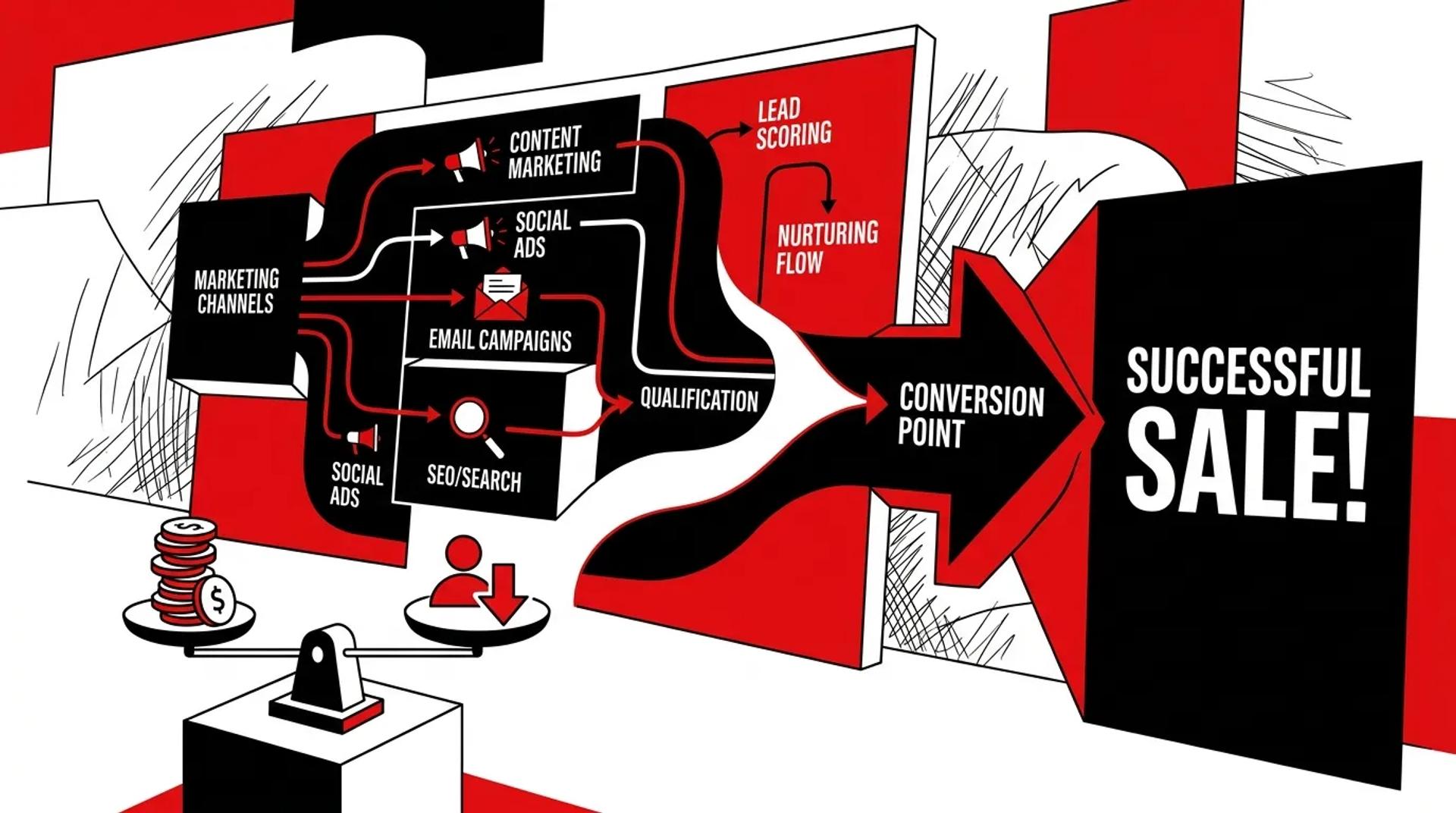
A real marketing attribution platform closes this gap by connecting marketing spend to actual revenue outcomes. Not clicks. Not form fills. Booked jobs, closed deals, and dollars collected. Here is what that looks like and why it changes every budget decision you make.
Why CPL alone creates bad decisions
Cost per lead is the most common metric agencies report and the most misleading metric business owners rely on. Here is why it fails:
CPL treats all leads equally. A spam call, a price shopper, and a ready-to-book homeowner all count the same in a CPL calculation. If your $45 CPL includes 40% unqualified leads, your real cost per qualified lead is $75. And your cost per booked job might be $200+.
CPL ignores conversion rate variation by channel. Google Ads might deliver leads at $50 CPL with a 30% booking rate. SEO delivers leads at $80 CPL with a 60% booking rate. If you only look at CPL, you overinvest in Google Ads and underinvest in SEO. The math flips completely when you factor in downstream conversion.
CPL does not account for revenue per job. A lead from a “furnace replacement” campaign might cost $150 but produce a $8,000 job. A lead from an “AC tune-up” campaign costs $30 but produces a $99 job. CPL says the tune-up campaign is 5x more efficient. Revenue attribution says the replacement campaign is 10x more valuable.
| Metric | Channel A | Channel B |
|---|---|---|
| Leads | 100 | 50 |
| Cost per lead | $40 | $90 |
| Booking rate | 25% | 55% |
| Booked jobs | 25 | 28 |
| Average job revenue | $500 | $2,200 |
| Total revenue | $12,500 | $61,600 |
| Marketing spend | $4,000 | $4,500 |
| Revenue per dollar spent | $3.13 | $13.69 |
| Cost per booked job | $160 | $161 |
Channel A looks better on CPL. Channel B generates 5x more revenue per marketing dollar. Every business relying on CPL alone would shift budget toward Channel A and lose money.
What a stronger attribution model includes
A proper marketing attribution platform tracks the full journey from first click to collected revenue. Here are the layers that matter:
Layer 1: source attribution
Which channel, campaign, and keyword drove the initial engagement? This includes paid search, organic, LSA, social, email, direct mail, and referral sources. Every touchpoint gets tagged.
Layer 2: lead qualification
Was the lead a real opportunity? Your CRM or field service platform should classify every lead as qualified, unqualified, existing customer, or spam. This separates signal from noise.
Layer 3: conversion tracking
Did the qualified lead become a booked appointment? And did the booked appointment actually happen? No-shows and cancellations are real costs that CPL ignores entirely.
Layer 4: revenue attribution
What was the invoice total for the completed job? This connects marketing spend directly to dollars collected. It also allows you to calculate revenue per marketing dollar by channel, campaign, and keyword.
Layer 5: lifetime value signals
Did the customer rebook? Leave a review? Refer someone? First-job revenue is the starting point, but the best attribution models flag which channels produce customers with the highest repeat and referral rates.
How CRM and revenue data change the picture
The bridge between marketing data and revenue data is your CRM or field service platform. Without this connection, you are making budget decisions based on half the picture.
Here is what integration with a CRM revenue attribution system enables:
- Channel-level P&L. You can calculate profit (not just revenue) per channel by factoring in marketing spend, job costs, and revenue. This tells you which channels are actually profitable, not just which ones generate activity.
- Campaign-level ROI. Within each channel, you can compare campaigns against each other using real revenue data. A branded search campaign and a non-branded campaign might have similar CPL but wildly different revenue outcomes.
- Keyword-level attribution. For paid search, connecting CRM data to keyword-level spend shows you exactly which keywords drive booked revenue. This allows precise budget reallocation within campaigns.
- Technician and CSR performance by source. Some channels produce leads that close at higher rates. But is that the channel quality or the technician quality? CRM integration lets you control for this variable.
What the connected view looks like
Without CRM integration:
“We spent $15,000 on Google Ads and generated 300 leads at $50 CPL.”
With CRM integration:
“We spent $15,000 on Google Ads. 300 leads came in. 180 were qualified. 95 booked. 88 showed. Those 88 jobs generated $142,000 in revenue. Our cost per booked job was $158 and our return was $9.47 for every dollar spent. Branded campaigns returned $14.20 per dollar. Non-branded returned $6.80. The HVAC replacement campaign returned $22 per dollar and should get more budget next month.”
That is the difference between reporting and attribution. One fills a slide deck. The other drives decisions.
What leaders should expect from reporting
If you are an owner, CMO, or operations leader evaluating your multi-channel marketing reporting, here is the standard you should hold your team or agency to:
Weekly reporting should include:
- Lead volume by channel and campaign
- Qualified lead count (spam and existing customers removed)
- Booking rate by channel
- Any anomalies or tracking issues flagged
Monthly reporting should include:
- Cost per booked job by channel
- Revenue generated by channel and campaign
- Revenue per marketing dollar by channel
- Month-over-month trend analysis
- Specific budget reallocation recommendations with rationale
Quarterly reporting should include:
- Full channel P&L analysis
- Lifetime value indicators by acquisition source
- Competitive landscape updates
- Strategic recommendations for the next quarter
Red flags in reporting:
- Agency only reports CPL and never mentions booked jobs or revenue
- No CRM or call tracking integration
- Reporting frequency is monthly or less
- Metrics are all platform-side (impressions, clicks, conversions) with no business-side data
- Budget recommendations are not supported by revenue data
The real cost of bad attribution
Bad attribution does not just waste marketing budget. It creates a cascade of bad decisions:
- Budget flows to the wrong channels. Low-CPL channels get more spend even though they produce low-value leads.
- High-value channels get cut. Channels with higher CPL but better downstream conversion lose budget because nobody tracked the full funnel.
- Agency relationships deteriorate. The business owner sees flat revenue while the agency shows improving CPL. Neither side has the data to resolve the disagreement.
- Hiring and capacity decisions miss the mark. If you cannot accurately predict lead flow by channel, you cannot staff appropriately for demand.
- Growth stalls. Without knowing which channels produce profitable customers, scaling spend is a gamble instead of a calculated move.
Frequently asked questions
How hard is it to implement a marketing attribution platform?
The technical integration is straightforward if your CRM or field service platform has an API (most modern platforms do). The harder part is process. Your team needs to tag leads consistently, your CSRs need to classify calls accurately, and your reporting cadence needs to be established. Most businesses can have a basic attribution system running within 30-60 days.
What if my agency pushes back on revenue-based reporting?
That is a signal worth paying attention to. An agency confident in their results will welcome revenue attribution because it validates their work. An agency that resists it may know that their platform-reported numbers do not hold up when connected to real business outcomes.
Is cost per lead ever a useful metric?
CPL is useful as a directional indicator within a channel, especially for spotting sudden changes. If your Google Ads CPL doubles overnight, that is worth investigating. But CPL should never be the primary metric for budget allocation. Revenue per dollar spent is the metric that matters.
Do I need a dedicated attribution platform, or can I build this in spreadsheets?
You can start with spreadsheets by manually connecting CRM data to marketing spend. But this breaks down quickly at scale and introduces human error. A purpose-built marketing attribution platform automates the data connection, updates in real time, and makes the insights accessible without manual work every month.
How Ad Leverage approaches attribution with n^sight
At Ad Leverage, we built n^sight because we got tired of the same problem: agencies reporting clicks and leads while business owners stared at flat revenue. n^sight connects your marketing platforms, call tracking, CRM, and revenue data into a single attribution view.
Every channel, every campaign, every keyword tied to booked jobs and collected revenue. Weekly reporting catches issues early. Monthly reviews drive budget reallocation based on actual ROI. No guesswork. No CPL theater.
References
- Google, “About attribution models in Google Ads”
- HubSpot, “The Complete Guide to Marketing Attribution”
- Forrester, “Marketing Attribution: Finding the Right Model”