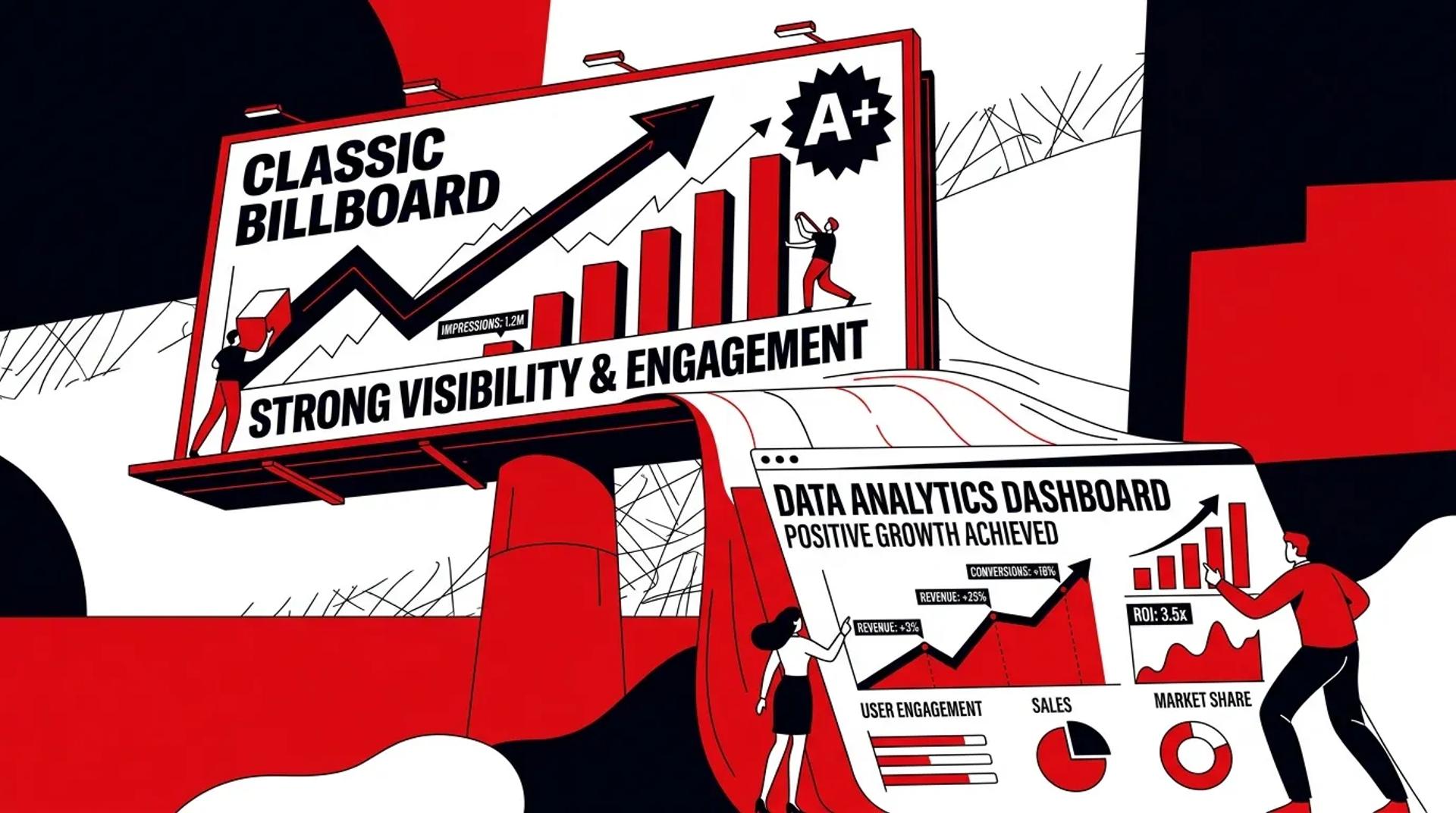

Billboards are one of the most misused channels in marketing. Brands either dismiss them as outdated or run them without any strategy beyond “let’s get our name out there.” Both approaches waste money. A real billboard advertising strategy starts with a simple question: does my business and my market fit the profile where OOH actually moves the needle?
Not every business should run billboards. But for the ones that fit, OOH is one of the highest-impact, lowest-CPM awareness channels available. It builds the kind of passive, repeated familiarity that makes every other channel in your mix work harder.
We have planned and managed billboard campaigns across dozens of markets. Here is the honest framework for deciding whether billboards belong in your performance media mix and what they should do if they are there.
What billboards are best at
Billboards excel at one specific job: building local brand familiarity through unavoidable, repeated exposure. A commuter who drives past your board five days a week for 12 weeks has seen your brand 60+ times. That kind of frequency creates a mental shortcut. When they need your service, your name surfaces first.
The strengths are specific:
- Geographic dominance. A billboard at a major intersection signals market presence to every person passing through. For businesses with defined service areas, this is efficient awareness.
- Impressions at massive scale. A well-placed board in a metro area generates 30,000-70,000 daily impressions. At a $3-5 CPM, no digital channel comes close for raw awareness reach.
- Zero-skip exposure. There is no ad blocker, no skip button, and no scroll. The impression happens passively and repeatedly.
- Competitive signaling. In categories where multiple businesses compete locally (HVAC, legal, dental, auto repair), billboard presence signals that you are a market leader. Absence signals the opposite.
When billboards belong in your mix
Not every business should run billboards. Here are the conditions where a billboard advertising strategy produces real returns:
You have a defined local service area
Billboards are a geographic targeting tool. If your business serves a 30-mile radius, billboards along major corridors within that radius are efficient. If you serve a national audience, billboards in a single market waste most of their impressions on people who will never be your customer.
Your digital channels are already working
Billboards create demand. Digital captures it. If your search ads, landing pages, and call tracking are not converting well, fix those first. Adding awareness to a broken funnel just sends more people to a bad experience.
You have budget for sustained flights
A 4-week billboard flight rarely produces measurable lift. Most campaigns need 8-12 weeks of sustained exposure. If you cannot commit $5,000-$15,000 per month for at least 3 months, the spend will not compound into results.
Your category benefits from trust and familiarity
Service businesses where the buyer needs to trust you before calling (legal, medical, home services, financial) benefit most from billboard awareness. Impulse-purchase categories benefit less.
| Business Type | Billboard Fit | Why |
|---|---|---|
| Home services (HVAC, plumbing, roofing) | Strong | Local, trust-dependent, recurring need |
| Legal services | Strong | High trust requirement, geographic focus |
| Dental and medical practices | Strong | Location-dependent, credibility-driven |
| Automotive dealers and repair | Strong | High-frequency local exposure valuable |
| E-commerce / national DTC | Weak | Geographic targeting wastes most impressions |
| SaaS / B2B tech | Weak | Audience too niche for broad OOH reach |
| Restaurants | Moderate | Depends on proximity to the board |
What needs to be true before you invest
Before you sign a billboard contract, confirm these fundamentals:
- Your digital infrastructure is solid. Search ads are running. Your website converts. Call tracking is in place. Billboards will drive branded searches and calls. You need to be ready to capture them.
- You have baseline data. Record 8 weeks of branded search volume, direct traffic, and call volume before the billboard goes live. Without a baseline, you cannot measure lift.
- You know your target commute patterns. Understanding how to choose billboard locations starts with knowing where your target customers drive. Near your location, along major highways in your service area, and near competitor locations are the three primary placement zones.
- You have a simple, clear creative. Seven words or fewer. Brand name visible. One memorable visual. Billboards that try to communicate a complex message fail because viewers see them at speed.
How to connect billboards to digital channels
A billboard running in isolation is a branding play. A billboard running with coordinated digital support is a performance play. Here is how to connect them:
Geographic alignment
Run geo-targeted digital ads in the same area the billboard covers. The audience sees your board on the highway and your ad on their phone the same day. Multi-touch exposure accelerates recall and conversion.
Sequential messaging
The billboard introduces your brand with a simple, memorable message. Your digital ads deepen the relationship with testimonials, offers, and case studies. Each channel builds on what the previous one established.
Branded search capture
When the billboard drives branded searches (and it will), branded search ads ensure you capture that traffic. Do not rely on organic rankings alone. Competitors may be bidding on your name.
Lift measurement
Compare OOH advertising ROI by tracking branded search, direct traffic, and call volume in billboard-active markets versus inactive markets or pre-flight baselines. This gives you a defensible answer for what the billboards are contributing.
How Ad Leverage plans billboard campaigns
Our billboard advertising strategy is data-driven from the start. We do not guess at locations. We do not run billboards as a standalone channel. Here is the process:
- Market analysis. We analyze traffic patterns, your service area, competitor locations, and your existing customer zip codes to identify the highest-impact placement zones.
- Location scoring. We evaluate available inventory by daily traffic count, visibility, speed of passing traffic, and relevance to your target audience. This is how we determine how to choose billboard locations that actually perform.
- Creative development. We design billboard creative that follows the 7-words-or-fewer rule with clear brand identity and a single memorable visual.
- Digital coordination. Digital campaigns launch with matching geo-targeting. Branded search campaigns are activated or expanded.
- Measurement and optimization. Weekly lift reports track branded search, direct traffic, and call volume. Underperforming locations get swapped. High performers get extended.
The result is a billboard campaign that has a defined job (awareness), a defined audience (your service area commuters), and a defined measurement plan (branded search and call lift). No guesswork.
Frequently asked questions
How much does billboard advertising cost?
Billboard costs vary by market size and location quality. Expect $1,500-$5,000 per month for a standard static board in a mid-sized market. Digital (rotating) boards run $2,500-$8,000 per month. Premium highway positions in major metros can exceed $15,000 per month.
How long should a billboard campaign run?
Minimum 12 weeks for a first campaign. The first 4-6 weeks build frequency. Weeks 6-12 are where you see measurable lift in branded search and call volume. Pulling a billboard at week 4 is the most common mistake we see.
Are digital billboards better than static?
Digital boards give you flexibility to change creative and share the cost through rotation. But you share the screen with other advertisers. Static boards give you 100% share of voice at that location, 24/7. For brand dominance in a specific corridor, static usually wins. For flexibility and lower commitment, digital boards are the better entry point.
Can small businesses afford billboard advertising?
Yes, with the right expectations. A single static board in a mid-sized market can start at $1,500 per month. Pair that with $3,000-$5,000 in digital support and you have a viable local awareness campaign. The key is sustained commitment (12+ weeks) and realistic measurement expectations.
Ready to see if billboards fit your mix?
If you are evaluating whether a billboard advertising strategy makes sense for your business and market, Talk to a Traditional Media Strategist. We will assess your fit, recommend locations, and build a plan that ties OOH spend to actual revenue.
References
- OAAA (Out of Home Advertising Association of America), OOH Media Cost and Effectiveness Benchmarks
- Nielsen, Out-of-Home Advertising and Brand Recall Research
- Google, Studies on OOH Exposure and Branded Search Volume Impact