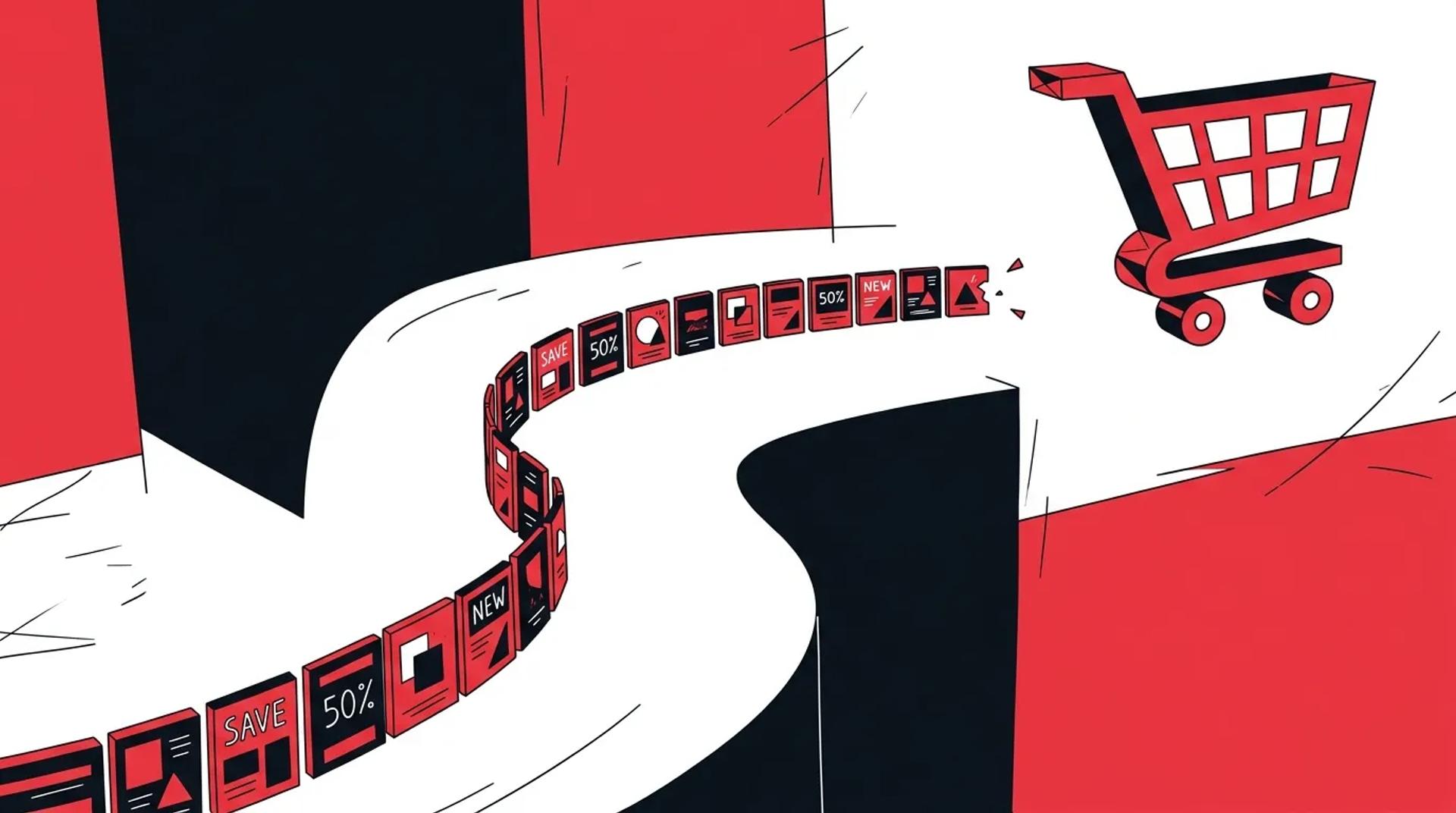

The typical remarketing campaign strategy goes like this: set up a “all website visitors, last 30 days” audience, upload one set of banners, launch, and forget. Conversions trickle in for two weeks. Then performance tanks. The team pauses the campaign and moves the budget somewhere else.
The campaign did not fail. It was never set up to succeed past week two.
Remarketing is one of the highest-ROI tactics in paid media. But most teams treat it like a set-and-forget checkbox. They build one audience, run one message, and wonder why the results plateau. The reality is that a proper remarketing campaign strategy requires segmentation, sequencing, and creative rotation. Without those three, you are just showing the same stale banner to the same burned-out audience on repeat.
What causes remarketing to plateau
Every remarketing campaign has a natural decay curve. The audience sees your ad, some convert, and the rest develop banner blindness. Without intervention, click-through rates drop 40-50% within the first 14 days.
Three factors accelerate the plateau:
- Audience saturation. A 30-day all-visitors list refreshes slowly. Once you have shown ads to most of the pool, frequency skyrockets and engagement drops.
- Creative fatigue. The same banner shown 15+ times stops registering. It becomes visual noise. Users do not just ignore it. They develop negative associations with your brand.
- No sequencing. Someone who visited your pricing page and someone who bounced after 3 seconds are in the same audience. They need completely different messages.
The frequency problem
We audit remarketing accounts where average frequency exceeds 25 impressions per user per week. At that level, you are not remarketing. You are harassing. The cost per incremental conversion climbs exponentially while brand sentiment takes a hit.
The sweet spot for most verticals is 5-8 impressions per user per week across all remarketing placements. Anything above 12 shows diminishing returns in almost every account we manage.
How audience freshness affects results
Recency is the single most important variable in remarketing performance. A user who visited your site yesterday is 5-10x more likely to convert than someone who visited 25 days ago. Yet most advertisers lump them into the same audience.
Segment by recency to unlock performance:
| Audience Segment | Window | Expected CTR | Expected Conv Rate | Message Priority |
|---|---|---|---|---|
| Hot visitors | 0-3 days | 0.8-1.5% | 3-6% | Direct offer, urgency |
| Warm visitors | 4-14 days | 0.4-0.8% | 1-3% | Reinforce value prop, social proof |
| Cool visitors | 15-30 days | 0.2-0.4% | 0.3-1% | Re-engage with new angle |
| Cold visitors | 31-90 days | 0.1-0.2% | 0.1-0.3% | Brand awareness, blog content |
The budget allocation should follow the conversion probability. We typically put 50-60% of remarketing spend against the 0-14 day window where display ads ROI is highest.
Page-level segmentation
Beyond recency, the pages someone visited tell you where they are in the decision process. Build separate audiences for:
- Pricing/quote page visitors. These are your hottest prospects. They were evaluating cost. Hit them with a direct CTA.
- Service page visitors. They showed interest in a specific offering. Match the remarketing creative to the service they viewed.
- Blog readers. They are in research mode. Offer a guide, checklist, or case study to pull them deeper into the funnel.
- Homepage bouncers. Low intent. Either exclude them or target with broad brand messaging at minimal spend.
Why sequencing matters
Sequencing means showing different messages at different stages of the remarketing window. Instead of one static ad forever, you build a narrative that evolves over time.
A basic three-stage sequence:
- Days 1-3: Reinforce the visit. Remind them what they looked at. Show the specific service or product. Use urgency if appropriate.
- Days 4-14: Build trust. Shift to social proof. Customer testimonials, review counts, case study results, industry certifications.
- Days 15-30: Change the angle. If they have not converted by now, the original message did not resonate. Try a different value proposition, a different offer, or educational content.
Each stage uses different creative and different landing pages. This is not complex to build. It requires 3 ad sets per funnel stage and 3-4 creative variants per set. Most teams can launch this in a week.
The difference in performance is significant. Sequenced remarketing campaigns in our accounts consistently deliver 30-50% lower cost per conversion compared to single-message campaigns targeting the same audiences.
How to refresh creative without restarting from zero
The fear with creative rotation is losing the performance data you have accumulated. Teams hesitate to swap creative because they do not want to “reset the algorithm.” Here is how to handle it.
Rotate, do not replace.
- Add new creative variants to existing ad groups rather than pausing winners outright
- Test 2-3 new banners alongside your top performer each month
- Let the platform optimize delivery between old and new assets for 7-10 days before making decisions
- Retire creative only after CTR drops below 50% of its peak performance
What to change in each refresh cycle:
- Headline and CTA copy. The fastest lever to pull. Test different angles on the same visual.
- Color and layout. A visual refresh combats banner blindness without changing the message.
- Offer or proof point. Swap the testimonial, update the stat, or change the promotion.
- Format. If you have been running static banners, test responsive display ads or HTML5. Format variety alone can lift performance 10-20%.
The budget question
A common objection is that creative production costs eat into display ads ROI. In practice, responsive display ads require only a few headlines, descriptions, images, and your logo. Google assembles the combinations. You do not need a design agency for every refresh.
For clients spending $5K+ per month on remarketing, we recommend allocating 10-15% of that for creative production and testing. The return on that investment compounds every month as you build a library of proven assets.
How Ad Leverage extends remarketing value
We build remarketing campaign strategy as a system, not a campaign. Every client gets recency-based audience segmentation, sequenced messaging, and a monthly creative rotation calendar. We connect remarketing performance directly to CRM data so we know which audiences and messages drive booked jobs, not just clicks.
Our display ads strategy framework:
- Audience architecture. Segment by recency, page depth, and funnel stage.
- Sequenced messaging. Three-stage creative strategy aligned to the buyer journey.
- Frequency management. Hard caps and cross-channel coordination to prevent fatigue.
- Monthly creative refresh. New variants tested against proven controls.
- Revenue attribution. CRM-matched reporting on cost per booked job by audience segment.
Most remarketing campaigns stop delivering because nobody is actively managing them. The ones we run keep producing because the system is designed to evolve.
Frequently asked questions
How long should a remarketing audience window be?
For most service businesses, 30 days is the default and 90 days is the maximum useful window. The critical move is segmenting within that range. A 0-7 day audience and an 8-30 day audience with different messages will outperform a single 30-day list every time.
How many remarketing ad variants do I need?
Start with 3-4 variants per audience segment per stage. That gives the platform enough options to optimize delivery while giving you meaningful test data. Over time, build toward 8-12 active variants across your full remarketing funnel.
Is display remarketing still effective with cookie deprecation?
Yes. Google’s remarketing audiences are built on first-party data from signed-in users across Google properties, which is not affected by third-party cookie changes. You will see some audience size reduction on the open web, but the core targeting capability remains strong. First-party data strategies (email lists, customer match) become even more valuable as a supplement.
What is a good benchmark for remarketing cost per conversion?
It varies by industry, but remarketing should generally deliver a 30-50% lower cost per conversion than prospecting campaigns. If your remarketing CPA is higher than your Search CPA, something is broken in your audience setup or creative strategy.
Get started
If your remarketing campaigns flatlined and you moved the budget elsewhere, the problem was probably the setup, not the tactic. Talk to a Paid Search Strategist and we will audit your current remarketing architecture and show you what a properly sequenced system can deliver.
References
- Google Ads Help Center. “Best Practices for Remarketing.”
- SEMrush. “Display Advertising Benchmarks Report.”
- HubSpot. “The Complete Guide to Retargeting Campaigns.”